Wednesday, 16 March 2011
Latino American Immigration
Anti
Within this article the Republican Party convey their strong opinions on Latino immigration. The Republican Party wants to do everything in its power to keep America as white as can be. They have blocked the minorities from voting and demanded that Latinos hand over papers if the police ask for them. The Republicans are clearly at risk of losing voters across the Latino population, which make up a big number of Americas people. It could be argued that it they continue down this path and attempt to clutch onto this power by rebuffing citizenship, Latino will have little voting privileges and this will further to minority groups in Americans. The Republicans appear quite tough within the article, their message; however, is a very political miscalculation. I believe this could lead to the isolation of millions of Latinos, who are increasingly becoming the quickest growing minority group in the country. The article regards the issue of banishing immigrants and further stopping immigrants from crossing over the border in the future. Their prejudice triggers mayhem in local communities that take their political recommendations to personally and are reinforcing racial tensions across the country.
Pro
http://pewhispanic.org/newsroom/releases/release.php?ReleaseID=2
http://pewhispanic.org/newsroom/releases/release.php?ReleaseID=21
The Latino immigrants that flock American jobs can be seen to be blamed for the misfortunes of less skilled Americans. This website tends to be more in favour of the Latino people, and believes that immigrants and native-born workers tend to meet the demands for different types of work. Immigrants are employed in jobs that natives are not willing to do in any case. Whites in America, the largest group of workers in the economy, are searching for new jobs in such diverse occupations that they seem to be on different paths in the labour market. The list of statistics on the website, indicate that the Latino immigrants are not hurting the chances of taking jobs that Americans want. The recent influx of Latin Americans provide cheap services and do jobs that free up time of Americans for more specific tasks. The website states that the decrease in wages for Latinos was highest among immigrants who arrived in the U.S within the last five years. Therefore, the newest immigrants who are benefiting from a considerable growth in employment are doing so at the expense of lower wages. This is further reinforced by their concentration in occupations calling for minimal skill and education.
Southwest border issues: illegal immigration
'The underlying truth about illegal Latino immigration'
http://socyberty.com/sociology/the-underlying-truth-about-latino-illegal-immigration/
Some of the points the article makes and questions it raised for me:
"Once upon a time there was a land known as America; the land of opportunity and it is said that it was built by immigrants… “The American Dream” is the phrase that better describes this opportunity for many Latino immigrants who come to this country pursuing a better life for their families, escaping a country that doesn’t offer them the lifestyle they dream of." Is everyone entitled to live 'the dream' should America share it's wealth and resources with those who live in poverty?
"As a result of propaganda and cultural misconceptions, many Americans had developed an aversion to Latinos, even though most of them are legally living here... the illegal immigration will continue as long as their labor is solicited." Does America need the labour? What would happen if it suddenly stopped? Is this similar to the issue of guns & gun control, in the sense that the problem already exists and can't be undone/stopped? Would Americans take the jobs that illegals do, such a service work and manual labour, are people that use services known/suspected to be using illegal workers guilty too?
"The question many people ask is why? Why bother creating laws to legalize the illegal? Many Americans I’ve spoken to, say the solution is sending back all of those without documents. What they don’t realize is that thanks to many Latinos “we are able to have, albeit illegally, child care for our children, elder care for our parents, have our lawns mowed, our nails manicured, our roofs re-shingled, our trees trimmed, our stone walls built, our restaurant meals prepared and served, and our homes cleaned, at prices that are within reach of most of us, thanks to the immigrants” (Warner Cooper 2007)" So does the government of America really want rid of illegals, or does it just want to appear to? Many politics would have invested/interests in many companies/corporations that wouldn't want to see laws of immigration or illegal workers changed.
"However, if we go back in history, Latinos have been in this country even before the first European settlers became Americans." The fact that states such as Texas once were part of Mexico has created mass debate- if Mexico is entitled to several states how would that be orchestrated? Is it even possible, considering the situation of Native Americans and the little amount of land (comparatively) they have managed to reclaim.
"Also, treating these workers as human beings giving them rights just for the sake of humanity and stop seeing them as criminals because they crossed the border to make a better life by working; we’re not giving them anything for free. According to Warner Cooper (2007) “ If employers can’t find ways to hire these workers legally, American workers take the jobs at higher wages, and this will greatly increase the cost of living for all of us.”
Anti Illegal Immigration:
(Not too hard to find...)
Some of the points raised:
"We are a nation of laws"
"Put illegal aliens above the American citizen… we are responsible"
"When we sit silently when illegals take our jobs, steal our identity, abuse our charity, and live off our social services, we are responsible" (How can an illegal live off social services- no social security number, does every immigrant have the knowledge to commit fraud, if so why are they not caught by police and deported? It seems more likely that they live a very quiet undercover life. 'Our' jobs, were they wanted to begin with?)
"We will take back America" Fears of it being 'over-run', realistic?
Conclusions:
Rather than sympathy, practical economy linked factors are being used to justify/argue that illegal immigration is healthy for the country. Many in favour of Latino American rights argue that certain areas of the U.S 'belong' to Mexcico, this came up alot in the debate of illegality- how can you say it is 'illegal' to live in a land occupied by ancestors? It seems that although most illegals come to America (as many immigrants have before) for a better life there is little sympathy for them, and returning them to poverty/suffering seems acceptable to most people.
21st century America, a 'nation of nations' that allows freedom and prosperity to all has decided that illegal Latinos aren't included in the American dream. I wonder what their desperate ancestors would make of their pleas for a better life...?
Monday, 14 March 2011
Latino Immigration
http://www.youtube.com/watch?v=jHnzn2KT7JE&feature=related
http://www.google.co.uk/#hl=en&xhr=t&q=FairUS.org&cp=7&pf=p&sclient=psy&rlz=1W1ACAW_ http://www.numbersusa.com/content/
http://www.capsweb.org/
This video features a Mexican nationalist movement which talks of Aztlan, the name give to the areas in the United States lost to Mexico. Supporters consider Mexicans have an enduring right to live in the United States as their homeland, land taken from them in the conflicts of the nineteenth century. It wasn’t until the end of this video that I realised it was being used as warning propaganda on behalf of three organisations seeking reduction in immigration:- FairUS.org, The Federation for American Immigration Reform, NumbersUSA.com – in favour of lower immigration levels, and CAPSweb.org (Californians for Population Stabilization), but the video was interesting.
Both opinions seem deeply entrenched and it’s hard to see a viable solution. The Republican fears are of too many ‘alien’ immigrants pouring into the country and failing to assimilate (to become American) There is great opposition in Mexico to the Arizona Immigration Law. A Republican view put across by Congressman McClintock is right wing and exclusive but may well be a view held by a large percentage of the population, especially those living in the States most affected by the immigration question, citing their numbers and their language as two threatening aspects. The Mexican viewpoint seems to be more linked to what they see as their human rights and in the case of the Aztlan support.
Jill Glazier
Latino Immigration
The following video features Republican congressman Tom McClintock
http://www.youtube.com/watch?v=-JDo36xPYgE&feature=related
McClintock is responding to what the President of Mexico Felipe Calderon said on a visit to the US congress on the subject of Mexican immigration into the United States. He talks about the values of an Anglo-American society, speaking English and having total allegiance to being an American and nothing else. He talks of the E pluribus unum ("Out of the many, one") being eroded.
Thursday, 10 March 2011
African American Segregation
At the beginning of the 20th an image like this was very common, with white Americans being seen as the superior citizens to that of the African American community. This idea was promoted by the separation of African Americans on public transport, in schools, in cafes and in restaurants as well as many other places.
This image that I have chosen is a very good example of how extreme the segregation between the two races was, and really shows that African Americans were depicted as second class citizens to white Americans. The fact that African American’s could not even share water from a water fountain with the white American community suggests that they would make the water “dirty” or “unclean” for what was seen at the time as the higher class citizens. Even the different water fountains show how little respect African Americans were shown at this time. The water fountain for white Americans looks much nicer, whilst the one for African Americans is much less substantial and it doesn’t look as nice. This is a very good example of how African Americans were depicted through society at the time, they were given less pay and were given nowhere near the same amount of respect as white American citizens.
African American Separatism

Louis Farrakhan, born Louis Eugene Walcott; May 11, 1933, is known by his followers as being “a better orator than Martin Luther King Jr., a better author than Norman Mailer, a better diplomat than Henry Kissinger, and more handsome than Muhammad Ali.”
According to founder Wallace D. Fard Muhammad, the Muslim Cult of Islam started in July 4, 1930. Ford declared he was sent to wake “the black nation to the full range of the black man’s possibilities in a world temporarily dominated by the blue-eyed devils.” He taught that the African American culture was unique and separate from that of “the Caucasian devils.”
Elijah Poole, Fard’s first assistant and one of his most loyal followers, told members of the Cult that Fard “had returned to Allah” and that Poole had been selected to succeed him. He changed his name to Elijah Muhammad and moved the sect, now called the Nation of Islam, to Michigan and then to Chicago: the “New Mecca.”
Farrakhan became a member of the Nation of Islam under the leadership of Malcolm X in 1955. Louis worked devotedly learning the teachings of Elijah Muhammad and eventually moved up into ranks of leadership in the movement. He eventually became “the Honorable Elijah Muhammad’s national spokesman.”
Wednesday, 9 March 2011
African American Separatism: Black Power at the Olympics
The iconic image of athletes Tommie Smith and John Carlos raising there hands in the Black Power salute after receiving the Gold and Bronze medals for the 200m at the 1968 Olympic Games is one that made a massive impact on the African American Separatist movement, bringing the issue of American Civil Rights to a huge worldwide audience.
Smith and Carlos received their medals shoeless, but wearing black socks, in a representation of poverty for African Americans. Also, Smith wore a black scarf around his neck to represent black pride, Carlos unzipped his tracksuit top in a show of solidarity for all blue collar workers in the U.S. and wore a necklace of beads which, as he described "were for those individuals that were lynched, or killed and that no-one said a prayer for, that were hung and tarred. It was for those thrown off the side of the boats in the middle passage."
Along with Smith and Carlos, silver medallist Peter Norman, a white Australian, wore badges in support of the Olympic Project for Human Rights. Norman, a known critic of his country's "White Australia Policy" expressed empathy with the American athletes' ideals, even suggesting that Carlos, who had actually left his set of black gloves back at the Olympic village, wear Smith's left glove so that they could both give the salute.
The outcry that ensued in the aftermath of the event was staggering. It made front page news across the world and truly became one of the most iconic images in the Black separatist movement, due to its iconography and association with the Black Panther party. The US sporting establishment ostracized Smith and Carlos and were widely criticised by the mainstream media. After their immediate suspension from the Olympics and upon returning home, they were subject to death threats and abuse. Even Peter Norman received a similar reaction in Australia. The media lambasted him for his part in the protest and he was reprimanded by the Australian Olympic authorities, leading to his non-selection for the 1972 Olympics despite coming third in trials.
By protesting in this way Smith and Carlos asked the question that if they were good enough to represent the USA and win medals for their country in the Olympics, then why were they still not good enough to be a fully fledged citizen of American society? As Tommie Smith said soon after winning the Gold medal, "If I win, I am American, not a black American. But if I did something bad, then they would say I am a Negro. We are black and we are proud of being black. Black America will understand what we did tonight."
Separatism among African Americans
http://www.todayszaman.com/newsDetail_getNewsById.action;jsessionid=A4260971CBC3EF6A294F33DDF8987FF7?load=detay&link=191456&newsId=191348
Separatism among African Americans aims to make separate institutions apart from ‘white America’. Some African Americans appear to be embracing such groups as the ‘Nation of Islam’ in part because of their feelings of disadvantage from a white dominated society in America. However there is evidence that in some quarters this may be looking towards forming a minority “state” within the U.S.
The article chosen shows this may be a leader in a group known as “Ummah” or “the brotherhood,” a mostly African-American group of Muslim converts, seeks to establish a separate Sharia law-governed state within the United States.
A leader of the ‘brotherhood’ appears to be H. Rap Brown now converted to Islam with the name Jamill Abdullah Al-Amin who is a convicted murderer and political black activist.
H. Rap Brown was well known for his behaviour in the 1960s and gained a reputation as the “violent left's least-thoughtful firebrand,” and was jailed for murdering a policeman. The defendant was one of the leading figures of the American Muslim community. His definition of non-violence includes his famous boast, “We’re gonna burn American down.” He was a member of the FBI’s Most Wanted, Black Panther Party, a revolutionary leftist organisation.
The article describes Abdullah as "a highly placed leader of a nationwide radical fundamentalist Sunni group consisting primarily of African Americans, some of whom converted to Islam while they were serving sentences in various prisons across the United States.".
The simple question here is whether the promotion of a Sharia law “state” by the “brothers” is compatible with the U.S Constitution? I believe the answer is no. There are aspects of the Sharia law that come into conflict with the U.S Constitution. Firstly, I will identify what the Sharian law is. Wikipedia states Sharia refers to the sacred law of Islam. “All Muslims believe Sharia is God’s law, but they have differences between themselves as to exactly what it entails, which will be difficult to discern what to apply when, but we’ll labour along for the sake of discussion.”.
“In Western countries, where Muslim immigration is more recent, Muslim minorities have introduced Sharia family law, for use in their own disputes. Attempts to impose Sharia have been accompanied by controversy, violence, and even warfare.”
During the Arab International Festival, there were recent incidents displaying the poor image of Sharia inside the United States and its incompatibility with American culture and law.
American is a melting pot of many nations. From Chinese to Italian, people come from all over the world and they blend together very well. However, the Muslims in America are becoming too much and this is reinforced as they wish the Americans to comply with their wishes and the Sharia Law. Americans, however, would like the Muslims to follow their own rules, dressing accordingly and worshipping in their homes and mosques only. Americans generally are concerned with Muslims preaching their religion or trying to convert them. The notion of freedom, democracy and human rights tend to be lost with the application of Sharia Law and under a Sharia based law in America, these concepts might soon be long forgotten.
Khalid Abdul Muhammad and black seperatism
After a 1993 speech at Kean College Khalid was condemned and removed from his position in the Nation of Islam by Louis Farrakhan, he then served as the National Chairman of the New Black Panther Party until his death in 2001. His views were considered controversial among most Americans, but his angry condemnations of white power gained him the support of many black youth.
On May 21, 1997, he delivered a heated speech at San Francisco State University in which he criticized Jews, whites, Catholics and homosexuals. He endorsed a Holocaust denial position, asserted Jewish control over U.S. policy, and alleged Jewish involvement in various conspiracies.[5]
In 1998, Muhammad organized the Million Youth March in New York City. The march was controversial from its inception as New York mayor Rudolph Giuliani denied organizers a permit, calling it a hate march. A court ruled that the event could go on but scaled back its duration and size. At the conclusion of the rally, just as Muhammad appeared on the stage to speak, the demonstration was interrupted by a low-flying police helicopter that acted as a signal for more than 3,000 police in riot gear, including some mounted on horseback, to come in and disperse the crowd. In response, Muhammad exhorted the rally participants to attack the oncoming police, to beat them with rails, and to shoot them with their own guns. Dozens were arrested, and 30 officers and five civilians were injured.[6][7] Mayor Giuliani said that the march turned out to be precisely what he predicted, “filled with hatred, horrible, awful, vicious, anti-Semitic and other anti-white rhetoric, as well as exhortations to kill people, murder people...the speeches given today should not occur [at] any place.”[6] In subsequent activism, Muhammad convened a second march in 1999 that drew roughly 90 participants and no incidents with the police, even though he made threats that his speech would include all his beliefs beforehand.
Audio clips of some of his speeches:
Quotes from the video above:'You'll find white on top black on the bottom'
'We're all in jail'
'American owes us repirations, the states of Mississipi, Alabama, Georgia, you have the Carolinas here, North and South, in that general area' (3.02-3.15)
'We are victims of white capitalism' (4.05)
(To an audience member) '400 years' (Audience member:'Yes sir') 'And I ask you your name sitting in the audience and you still give a white mans name...100 years up from slavery' (4.18-30)
'No i didn't find what my spiritual big brother Malcolm did in Mecca, I found Racism' (5.58)
The themes and ideas that Khalid Abdul Muhammad are clear, Black seperatism, reclaiming of Southern States, and Black supremacy. The ideas may seem extreme but have seeped into less radical forms of influence in popular culture such as music: In popular cultureMuhammad was notably featured by the hip-hop group Public Enemy on the introduction of its 1988 track "Night of the Living Baseheads," from the album It Takes a Nation of Millions to Hold Us Back:
“ Have you forgotten that once we were brought here, we were robbed of our name, robbed of our language. We lost our religion, our culture, our god...and many of us, by the way we act, we even lost our minds. ”
He also appeared in rapper Ice Cube's albums Death Certificate (1991) and Lethal Injection (1993) as a guest. On the former, Muhammad appeared on the tracks "Death" and "The Birth". On the latter, he appeared on the song "Cave Bitch," a song ridiculing white women who chase Black men. He also appeared on MC Ren's 1996 album The Villain in Black on the track "Muhammad Speaks," where he spoke about the history of rights of the African-Americans. Tupac Amaru Shakur's Makaveli album also features Muhammad on the track "White Man's World."
"We didn't land on Plymouth rock, the rock landed on us."
I have chosen a video showing a clip of Malcolm X giving his ‘Ballot or Bullet’ speech given on 3rd April 1964 in Cleveland Ohio, to demonstrate his promotion of separatist ideas:
Throughout the speech Malcolm emphasises the idea of African-Americans being separate and independent from American society. Near the beginning of the clip he states “We are African and we happen to be in America. We’re not American.” This implies that, although they are living in America as African-American citizens, they are in fact separate from America because of their ethnicity. This concept is understandable given the unequal and unfair treatment that African-Americans have endured at the hands of white Americans and ‘W.A.S.P’ culture, however unlike other Civil Rights speakers of the time, such as Martin Luther King Jr., Malcolm X celebrates this and promotes the idea of black separatism.
He goes on to say “We are people who formally were Africans who were kidnapped and brought to America… our forefathers weren’t the Pilgrims. We didn’t land on Plymouth Rock, the rock was landed on us.” This famous statement again emphasises the differences which separated – and to an extent still separate – white and black American society. Making reference to the Pilgrims in turn draws attention to the values and ideologies which are associated with them and the founding of America, such as freedom and opportunity. Stating that African-Americans did not land on Plymouth Rock suggests therefore that they are not entitled to the freedoms and opportunities that America is founded upon. By stating that the rock was landed on them reinforces this, suggesting that they have been victims of America and its ideology. This is again emphasised when he states “We were not brought here to be made citizens. We were not brought here to enjoy the Constitutional gift that they speak so beautifully about today.”
The clip finishes with Malcolm stating that “Our unwanted presence; the fact that we are unwanted is becoming magnified in all of American preachments today.” This again emphasises the fact that as African-Americans they are not wanted in America, and are therefore separate from America.
Throughout the clip Malcolm X continually emphasises the differences between white and black American society and the degree to which African-Americans are different and outside of American society, with white Americans being the enemy. By emphasising this concept of separatism he is celebrating it. Malcolm X was unlike any other Civil Rights campaigners of the time, including Martin Luther King Jr., who often praised America and encouraged assimilation as opposed to separatism.
Tuesday, 8 March 2011
The Black Separatist Movement
This blog site features the NBFSN (National Black Foot Soldier Network), part of the black separatist movement. They state that they do not advocate violence. The network has groups in a number of US cities. In this site, there is mention of three black men killed by police in Portland (Oregon), Muskegon (Michigan) and Los Angeles, in 2009. The following three links give information about these incidents.http://nationalblackfootsoldiernetwork.baywords.com/
http://www.demotix.com/news/511273/police-officer-frashour-fired-aaron-campbell-murder
http://www.mlive.com/news/muskegon/index.ssf/2009/09/investigation_into_julius_john.html
I couldn't find a Julius Jackson with regard to a shooting but I found a Julius Johnson, so assume there was a mistake on the link.
onpost.com/tag/oscar-grant-shooting
http://www.splcenter.org/get-informed/intelligence-files/ideology/black-separatist
The SPLC (Southern Poverty Law Centre) is based in Alabama. They say they are a non-profit making organisation dedicated to fighting hate and bigotry and seeking justice for vulnerable members of society. They clearly see the black separatists stand as being as racist as white against black racism. They quote Martin Luther King who said “violence begets violence”. They want to see sense and morality cut off the chain of hate. One paragraph in their site talks about Farrakhan, the leader of the black separatist group, The Nation of Islam:-
A leading example of a black separatist group is the Nation of Islam led by Louis Farrakhan. In 1997, and in less explicit ways since then, Farrakhan made clear that he had renounced none of the anti-white, anti-Semitic, anti-Catholic and anti-gay views of the previous Nation leader, Elijah Mohammed. Those beliefs include the view that Yacub, a renegade black "scientist," created whites 6,600 years ago as an inherently evil and ungodly people — "blue-eyed devils." Farrakhan has described Catholics and Jews, who he said practice a "gutter religion," as preying on blacks. He regrets the "tone" of a former principal subordinate who called for slaughtering white South Africans, but agreed with the message. He called for racial separatism and inveighed against interracial relationships.
It is hard to argue with the desire of many to see sense and morality break the chain of hate, but along with that has to be eradication of discrimination, which obviously some members of the active black community, do not see getting any nearer.
Jill Glazier
Thursday, 3 March 2011
US Immigration -
A useful map for discussion - where? why there? what consequences?
Good wishes,
John
Teaching on immigration in K-12 schools
Educators across the nation are struggling with the fallout from the highly charged national debate on the issues of immigration reform and border security. The indignant and emotion involved in the conflict are spilling over into schools and classrooms as students stage walkouts and engage in shouting matches. Wise teachers and administrators will use this time as a valuable citizen education opportunity and a way to connect the history-social science curriculum to real world issues. Interpretation of primary documents, organized debates, editorial writing opportunities, close analysis of news media, and placing the controversy in historical, economic, and political context are all appropriate classroom activities.
Wednesday, 2 March 2011
Studying Immigration in K-12 Schools
The K-12 website that I have found is the official site for Wrentham Public Schools, a group of schools in the town of Wrentham, Massachussets. This particular page outlines the areas of study on the topic of US immigration. It is taught throughout a child's school life, outlined as follows: "Immigration and related subjects are included in the curricula of most elementary schools, studied again in middle schools and then in greater depth in high schools." This shows how the subject of immigration and its role in the foundation of American society is a very significant one to teach as it is fundamental in understanding what it is to be an American, harking back to the days of de Crevecoeur.
One of the ways in which the subject of early US immigration is taught in Wrentham Public Schools is by giving 7th graders the task of researching a particular immigrant group in the United States and creating a "culture capsule" for the group. This "culture capsule" assignment involves decorating a shoebox and including in the "capsule" the following items:
"1. Flag of immigrant's home country. (Displayed on the outside, top cover of shoebox)
2. Map of the immigrant group's home country. Identify the location/area within the home country where the majority of your emigrant group migrated from.
3. U.S. map showing the locations where large communities of these people live today. (Label states or regions on map and shade the area in gray.)
4. Drawing, picture, or model of Ellis Island AND an extended response describing the history and significance of Ellis Island to American immigration.
5. Bar graph comparing the current numeric population of your immigration group to the current United States population.
6. Circle graph illustrating the % of the immigrant's population in relationship to the U.S. total population
7. Illustrations or pictures that represent events or laws that have affected this group
8. Examples of this group's contributions to American culture (i.e., customs, holidays, beliefs, foods, music, clothing, etc.) Use pictures, drawings, artifacts, etc. to illustrate these."
Another task set in Wrentham Public Schools is a biographical research task in which students are asked to select a famous immigrant and write a short biography about them as well as considering their impact on American culture today and the qualities that made them so successful. Students are also given the assignment of researching their own backgrounds and family histories to find out how their ancestors first came to the United States in order to fully understand that America is a nation of immigrants. Interviews, documents, and written reports are required as deliverables in this project. This task, as well as teaching the children about their own family history and their immigrant roots, also discourages prejudice against ethnic groups as the students are made aware that nearly every American descends from an immigrant and thus to discriminate against others for that would be contradictory.
All of these tasks show how the subject of US immigration in the 19th and early 20th century is presented to schoolchildren as a very important part of their history and how all of the different and diverse ethnic groups are integral in making the "American Mosaic" that exists today.
Immigration in the Classroom
Teaching of Immigration in K-12 schools.
The website I found above is an online recourse for Guilford County Schools, Greensboro NC. Several K-12 schools in North Carolina run by one board. The curriculum area immigration falls into is 'Social studies' and the information/links and activities on the website are aimed at children in grade 5, (10-11 years old) and includes basic information, focusing on the history of immigration, and Ellis island.
"In this activity, you will learn about the greatest human migration period in the United States history as well as the events that took place at Ellis Island. You will understand why the United States is called the nation of all nations.
During the years between 1820 and 1924, thirty-five million people came to America from countries around the world. Fo
r most of them, the trip to America was difficult and dangerous. When they arrived in America, most immigrants had to go to a place called Ellis Island outside of New York City. At Ellis Island, immigrants were inspected before they were allowed into the United States. By completing these activities, you will learn about some of these experiences."However there is a section about exploring immigration further, which links to this worksheet: http://teacher.scholastic.com/activities/immigration/index.htm called stories of today and yesterday. On that worksheet it gives examples of not just history, but more recent immigration to the U.S. It has a section where children who have recently moved to the U.S tell their story, and children have submitted questions for them. The focus is on legal immigration, often stated for 'a better life' from places such as Vietnam and India, there isn't any mention of European or illegal immigration.
This may be due to various reasons, such as, the young age of the children, 21st century immigration and the laws behind it are complex, historical immigration paints a 'nicer' fairer picture of a country that allows anyone to live there if they wanted a better life, and because little information is actually known about illegal immigration. The countries picked to showcase immigration are countries with typically lower standards of living, and countries that children might expect people to want to move from. There is no mention of acts that restricted the type of people entering (Chinese immigration acts) or of Slavery, again, because of the children's age, and the sensitive nature of the topics.
The Calhoun School.

The Calhoun School is a K-12 school situated on the Upper West side of Manhattan, New York City, and was founded in 1896 by Laura Jacobi (a German immigrant to the US) as ‘The Jacobi School’. Originally a small ‘brother-sister’ school, and then an all-girls school, it became a ‘co-educational, progressive school’ in 1969. Calhoun’s mission statement is: ‘to inspire a passion for learning through a progressive approach to education that values intellectual pursuit, creativity, diversity and community involvement.’
The Calhoun website provides a lot of information as to what curriculum is taught in its Lower, Middle and Upper Schools, with ‘Social Studies’ covering the subject of history and, in turn, immigration. While the website states that pupils in grades 2-4 of the Lower School study Social Studies, the real study of American History and immigration doesn’t appear to begin until the 8th grade:
‘Eighth Grade
AMERICAN HISTORY: The study of American History is the study of an ongoing experiment in democracy, the goals of which are freedom, equality, and justice for all citizens. American history is filled with the struggle toward these goals. The 8th grade curriculum places special emphasis on evaluating this American experiment. Students examine various periods of American history including the colonial and Revolutionary War eras, the Civil War and Reconstruction periods, the Gilded Age and Immigration, the Great Depression, the Cold War, the Civil Rights Movement and the Vietnam era. Students are immersed in these topics through literature, films, music, field trips, and primary source material. A three-day trip to Boston in the spring complements the study of colonial America, the Revolutionary War and abolitionism. Other field trips include a walking tour of the city and a visit to the Schomburg Center for Black Culture.
Interdisciplinary projects
• Course work on the Bill of Rights is complemented with an art project in which students exercise their freedom of expression to comment on a political issue.
• Students participate in a “trial” of abolitionist John Brown during the Civil War unit. Students prepare testimonies, cross-examinations, and opening and and closing arguments.
• The unit on 1960s protests culminates in mixed-media projects. In the past, students have written music, plays and speeches.’
Although the description provided doesn’t specifically state what is taught, we can see that the subject of ‘American History’ examines a number of different historical periods and events, including that of immigration. The fact that it is taught alongside topics such as the Civil War and the Civil Rights movement suggests that it is considered an important part of American history.
The Social Studies subject is also featured on the course list for the Calhoun Upper School, with required modules including ‘US History’, which is summarised as:
‘SOCIAL STUDIES 11: UNITED STATES HISTORY: 3 Mods
The Unfinished Journey toward Liberty and Justice for All
Why has liberty for some Americans typically coexisted with its absence for others? How have ideals of liberty changed over the course of U.S. history? Given the important role of compromise in our nation’s history, which of its leaders have accomplished most in terms of fulfilling America’s promise? In this required 3-mod sequence we will explore selected significant political, social, economic and cultural turning points in U.S. history, noting in particular our efforts to fashion a polity that can sustain the delicate balancing act between individual freedoms and national needs. Throughout our inquiries, students will explore the variety of narratives that constitute the American historical record, author critical reflections based on primary and secondary sources, conduct scholarly research, and engage in frequent debates and simulations in an effort to reconstruct the past that is so inextricably linked to our present. We will use Eric Foner’s Give Me Liberty! An American History as our text.’
Although it doesn’t provide specific information as to whether immigration will be studied on the course, it does state that students ‘will explore selected significant political, social, economic and cultural turning points in U.S. history’, of which immigration is an important part.
The details given on the Calhoun website are useful in understanding what attitude the school has towards such subjects as American history, and what topics within those it finds important to teach its students. The fact that they consider and understand immigration to be an important aspect of American history suggests that this is what they convey to their students. However, it seems that the topic of immigration is being presented as simply a part of American history and not an on-going process.
Tuesday, 1 March 2011
Teaching on Immigration in K12 Schools

http://findarticles.com/p/news-articles/patriot-ledger-the-quincy-mass/mi_8043/is_20050202/bringing-ideas-teaching-history-federal/ai_n47734449/?tag=rel.resl
This section of the above site I have copied, advertises a project to educators seeking historical resources, with recommendations from teachers as to its usefulness.
Bringing new ideas to teaching history
They'll pore over yellowed century-old papers. They'll kick around local history with a Pulitzer Prize-winning author. Some will make an all-expenses-paid trip to New York City to immerse themselves in immigration issues.
Then, after having thrown themselves into the deep end of American history studies, about 165 Weymouth teachers are expected to bring some fresh ideas to their K-12 social studies classrooms.
It's a good time to be a history teacher in Weymouth, one of 122 school systems nationwide to receive a competitive grant from the U.S. Department of Education. The town was awarded a three-year $900,421 grant designed to give teachers a chance to bone up on American history.
Marcia Hanabury, who has taught in Weymouth schools for 35 years, said she's really enjoying the chance to deepen her knowledge of history and to learn how to enhance her daily lesson plans. She's one of about 20 teachers taking part in weekly two-hour history classes at UMass.-Boston, paid for by the government grant.
"It's kind of tantalizing to think of the ways you can bring these ideas you're learning to the kids," said Hanabury, who teaches fifth grade at Adams Middle School. "We're just thrilled that we got this opportunity."..............................................................................
http://www.parklandsd.org/
Parkland School in Allentown, Pennsylvania
I looked at the Curriculum link of this school's website and ran down the links to the Grade 8's History and Geography sections. There it states that the children are taught about immigrants contributions to culture and politics and the importance of dversity in the United States. Under the Geography section, map skills are taught to analyse the flow of immigrants and to examine the pattern of immigration to the US in the twentieth century.
http://besthistorysites.net/USHistory_Immigration.shtml
The Herman Screiber School in Brooklyn New York
Their site as a long line of links. This one accesses a fascinating site all about Ellis Island, with several videos to watch, covering subjects such as Passing the Medical Inspection and Registering as an American Citizen. Students would enjoy the visual element here, engaging with the images and the commentaries which set the scene and relate experiences.
It is difficult to know how many face to face lessons are taught at any of the schools I looked at on the subject of immigration, but it is included in some of the curriculums. Not all schools have an obvious history department, but the Herman Schreiber School includes the subject under Social Studies. There are many teaching resource websites covering immigration.
Jill Glazier
Thursday, 24 February 2011
Thursday's tutorial on American Indians...
One point of further comment is to recommend the book by Ian Frazier "On the Rez." - a really interesting, humorous and sometimes painful account of current American Indians. Well worth reading.
It also happens to mention the story of the Wampanoag tribe that Juliet posted - the tribe that befriended the whites and participated in the first Thanksgiving. The tribe does , in fact, have its reservation lands; the tribe is thought to have become extinct in the 1800s, but in recent times they revived (how?) their tribal identity, went before a federal court to re-establish their rights to "stolen" land in 1989, and, eventually, after negotiation with Jackie Kennedy Onassis (!), won the right to reservation areas close to Cape Cod.
This is a much simplified account of the whole saga (see pages 78 to 80 in 'On the Rez') but it confirms the complexity of issues surrounding "Who is an Indian" and the use of lawyers to fight the present-day battles...
Good wishes,
John
Southern Ute Indian Tribe
http://www.southern-ute.nsn.us/Wednesday, 23 February 2011
The Cherokee Nation

The Cherokee Nation is one of the largest Native American tribes in the US, boasting a population of 288,749. The Cherokee Nation is based largely in Oklahoma, home to the Cherokee capital, Tahlequah, but tribe members are interspersed throughout Texas, New Mexico, California and Oregon.
http://www.cherokee.org/NewsRoom/FullStory/2841/Page/Default.aspx

It is the covering of stories such as this that help to establish Cherokee.org as an extremely useful resource for anyone that wishes to learn about the Cherokee Nation.
The Nez Perce (Nimiippu) Tribe


Images of Chief Joseph and of the Celilo Falls before the era of dam construction.
http://www.nezperce.org//
This is the official site of the Nez Perce tribe with many links to the different departments that deal with all aspects of tribal life. The link to the Lewis and Clark Lifelong Learning Project is particularly interesting with its further link to narratives from the expedition.
http://www.spartacus.schoolnet.co.uk/WWjoseph.htm
This site gives a full account of the life and achievements of Chief Joseph. He seemed to be a proud man and also a man who wanted to avoid bloodshed, but when circumstances required, he fought valiantly in 1877. The long march the tribe made into Canada ended in capture and hostage exchange. The tribe were eventually moved to a reservation in Oklahoma.
Celilo Falls
http://en.wikipedia.org/wiki/Celilo_Falls
Celili Falls retains great cultural significance for native peoples. In 2007, three thousand people gathered to commemorate the 50 year anniversary of the inundation of the falls, over which the native peoples were deemed to have perpetual fishing rights. The construction of the Dalles Dam in 1957 flooded the area, consuming the Falls.
Conflicts of interest over the dam illustrate the problems native peoples have in many parts of the country when up against the might of Government interests and the different cultural 'takes' on justice and land rights.
Jill Glazier
The Navajo-
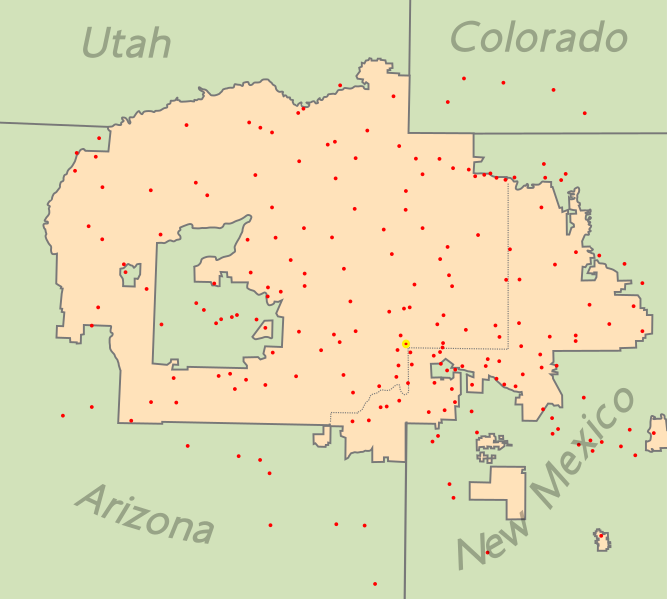
The land area of the Navajo Nation is 24,078.127 square miles (62,362.06 km2), making it by far the largest Indian reservation in the United States. It is almost exactly the same size as the state of West Virginia; it is slightly larger in land area, but slightly smaller if water area is included 24,096.295 square miles (62,409.12 km2).
The 2000 census reported 173,987 Navajo citizens, 58.34% of all ethnic Navajos, living on the Navajo Nation's territory. The Navajo Nation requires a blood quantum of one-quarter for a person to be an enrolled tribal member and to receive a Certificate of Indian Blood.
The history of the tribe is not as extensive as I expected, however the history of the government and reasons for existance were emphasised: "In 1923, a tribal government was established to help meet the increasing desires of American oil companies to lease Navajoland for exploration. Navajo government has evolved into the largest and most sophisticated form of American Indian government. The Navajo Nation Council Chambers hosts 88 council delegates representing 110 Navajo Nation chapters." I expected to see more about the traditions and origins of the tribe, but there is nothing on it. The history covered is from the 1920's onwards, the government, the flag, involvement in ww2 and the museum reccently built.
The situation of the Navajo tribe today is represented positively, with many successes in government/with laws. "Today, the Navajo Nation is striving to sustain a viable economy for an ever increasing population that now surpasses 250,000. In years past, Navajoland often appeared to be little more than a desolate section of the Southwest, but it was only a matter of time before the Navajo Nation became known as a wealthy nation in a world of its own." However other sources on the tribe reflect a grimmer situation. Taken from http://www.navajobusiness.com/fastFacts/Overview.htm
(2000 census)
Median Age: 24

Labor Force: comprised of 28% of the population
Median Household Income: $20,005
Unemployment: 42%
Poverty: 43% lives below the poverty rate
Education (for ages 25+): 56% high school degree
7% college degree
The rate of unemployment and number of people living below the poverty level suggests that economically many of those members of the tribe choosing to live in Navajo nation do not have a good standard of living in contrast to the rest of the U.S. The official trive website would want to put forward a more positive view, partially because a large amount of income on the reservation comes from tourism, and a more 'real' portrayal of poverty and hardship would put tourists off visiting.
The Aquinnah Wampanoag Tribe

The Native American Wampanoag peoples have inhabited the South-Eastern area of Massachusetts for hundreds of years. They consist of many different tribes, including the Mashpee tribe of Cape Cod, the Nantucket tribe of Nantucket Island and the Aquinnah (or Gay Head) tribe of Martha’s Vineyard.

The website I have chosen to evaluate is that of the Aquinnah tribe, which includes a page dedicated to their history, beliefs and culture. It states that the ‘ancestors of Wampanoag people have lived for at least 10,000 years at Aquinnah (Gay Head) and throughout the island of Noepe (Martha's Vineyard), pursuing a traditional economy based on fishing and agriculture. The Aquinnah Wampanoag share the belief that the giant Moshup created Noepe and the neighboring islands, taught our people how to fish and to catch whales, and still presides over our destinies.’
The Klamath Tribes
The Klamath Tribes, otherwise known as the Klamath Indian Tribe of Oregon are a federally accepted confederation of three Native American tribes who traditionally settled in Southern Oregon and Northern California, in the States: Klamath, Modoc and Yahooskin. The tribal government is found in Chiloquin, Oregon. The tribe is most closely connected to the Modoc tribe, who historically lived just south of the Klamath in parts of what is now Oregon and California. The Klamath and Modoc traditionally spoke two different dialects of a single language, Klamath-Modoc now extinct.
The Klamath Tribes website displays a list of topics dedicated to their history and the main picture has a slideshow running, with bright and attractive pictures of the tribe and the scenery in Chiloquin.
Their annual Restoration Celebration event marks the anniversary of the return of federal recognition for the Klamath tribes. They celebrate by hosting a big celebration with activities like, fun run/walk, powwow, parade, youth rodeo, vendors and more. This event is very important to the Klamath Tribe as their tribe was terminated in 1954. Twenty years later, the Federal Court ruled that the Klamath tribe engaged its right to hunt, fish, and gather and in 1986 the tribe regained federal recognition. With restoration in 1986 the Tribes began to expand a full range of programs which provide necessary services to Tribal members and the community. Today the Tribes operate with a budget of over $12 million annually, with over 30 different departments and services offered. This turn of event encapsulates the strength of mind the tribe encountered, they overcame huge problems and their hard work laid the foundations of today’s Klamath tribe.
Thursday, 17 February 2011
Women at work
This image is a very stereotypical view of "women's work", the stereotypical work of women being doing the cooking, cleaning, washing, and just general housework that needs doing around the home. The image shows this view of women very well as it is a woman who is doing the work, and she is in a kitchen setting doing the ironing, possibly ironing a shirt for her husband. As for the caption "housework rules!" this could be a sign that this is how women thought they should be, at home cleaning and cooking, rather than going out and getting jobs, this was instead left to their husbands.Whereas
this image shows a woman at work in a busy office environment. She is on the phone with lots of paper work and folders around her. This working woman is very different from the working woman seen in the previous image, she is out of the house and is in a paid job, rather than at home working to clean up after the children and her husband. This office job is seen as stereotypical "men's work" and not many women used to work in this environment, however nowadays, it is a lot more common to see a woman in this kind of working environment.